Lighter Workflows: The IDP Document Checker That Spots Mistakes Before Trouble Starts
Manual document review is a fundamental and trusted part of business.
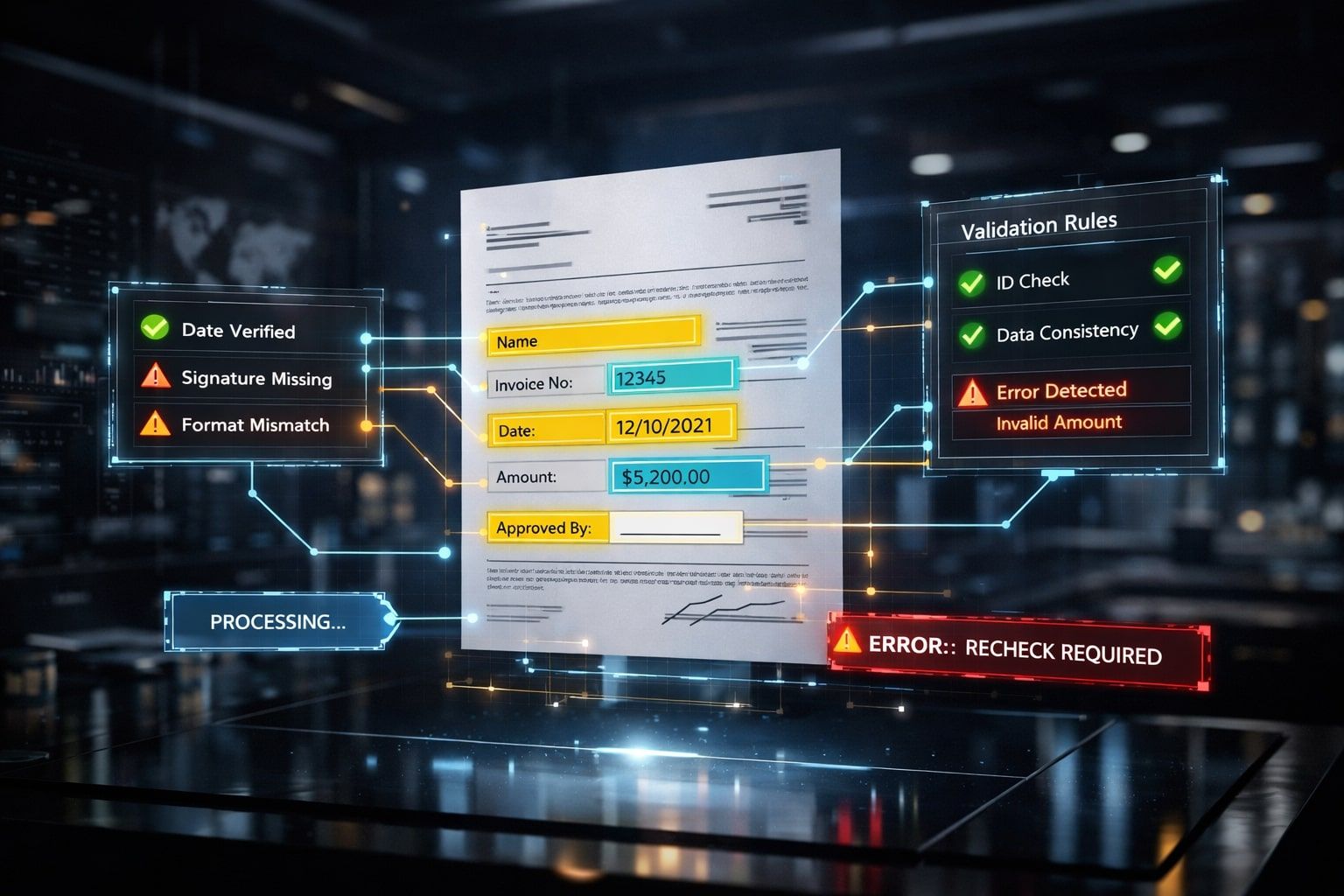
Manual document review is a fundamental and trusted part of business. Your team carefully examines contracts forms and reports using their experience to catch the nuances that matter. Yet as workloads grow the sheer volume can become overwhelming. That quiet worry of a missed detail during a long review session is a common and relatable challenge.
This is where an IDP Document Checker plays a practical supporting role. By introducing structured review earlier in the process organizations can reduce avoidable rework and address discrepancies before they affect downstream workflows.
Understanding the IDP Document Checker
An IDP Document Checker operates as a supportive quality control layer within a document workflow. Its primary function is to provide an initial structured review before documents advance into core operational processes.
Instead of replacing human judgment, the tool assists reviewers by systematically highlighting areas that may need closer examination. This supplementary layer helps organizations maintain greater consistency across document batches while keeping the review effort focused and manageable for teams.
See also: Optimizing Business Efficiency with Intelligent Document Processing
How the IDP Document Checker Fits into Operations
The IDP Document Checker integrates into your workflow as a practical early checkpoint. After documents are initially captured, they are routed to the checker where it applies your predefined business rules to validate the information.
This process includes verifying that required fields are complete, checking that data aligns with your existing records, or confirming that values follow the correct logic. Documents that pass all validations move forward automatically to the next stage, such as approval or filing. Documents that trigger a rule are flagged for human review with clear notes on the specific issue.
This creates an efficient division of tasks. The system handles routine, rule-based validation with consistency. Your team can then focus their attention on reviewing the flagged items, applying their judgment to complex cases, and managing decisions that require greater context. The result is a workflow that supports accuracy while allowing your staff to concentrate on higher-value work.
Common Use Cases for an IDP Document Checker
An IDP Document Checker supports critical business operations by automating initial document validation, which is especially valuable in high-volume, rules-driven processes. Here is how it functions across key areas:
- In client onboarding, the system checks for complete application forms, validates the format of identification numbers, and confirms that required supporting documents are attached. This reduces manual review time and allows staff to focus on nuanced verification and complex cases.
- For invoice processing, the tool verifies vendor information against master records, ensures mathematical accuracy in totals and taxes, and checks for duplicate invoice numbers. This helps prevent payment discrepancies and creates a more efficient accounts payable workflow.
- In legal and contract management, it performs an initial scan to confirm the inclusion of mandatory clauses, the accuracy of dates and party details, and the alignment with standard compliance frameworks. This foundational review allows legal teams to begin their examination with baseline assurance.
Explore more: The Future of Document Smart Processing: AI-Driven Efficiency and Automation
Considerations Before Implementation
Before introducing an IDP Document Checker into an existing workflow it is important to assess several practical factors to ensure the tool supports operations rather than adding unnecessary complexity. Document checking relies on clearly defined validation rules so organizations benefit from identifying which rules are currently handled manually and which can be applied consistently through automation. The level of document variety also plays a role since differences in format and structure can affect how effectively documents can be reviewed.
In addition teams should consider where document checking fits best within the workflow since earlier checkpoints often provide more value depending on downstream processes. Although checking is automated human review remains essential so ownership for reviewing flagged documents and making final decisions should be clearly defined. Successful adoption also depends on change management including clear communication and a gradual rollout to help teams understand the role of the document checker within their daily work.
Practical Next Steps
For teams looking to improve document review without disrupting existing workflows the next step often starts with evaluation. This includes identifying where document issues most frequently occur and which validation steps are still handled manually. These areas provide a practical entry point for introducing structured document checking in a controlled way.
Within the AssistX Suite the IDP Document Checker can be adopted as part of a modular approach to document processing allowing teams to apply it where it adds the most value. Organizations can begin by testing the checker on a limited set of document types and aligning validation rules with existing review practices before extending it across additional workflows while maintaining operational stability.
Related article: When Document Overload Slows Productivity: How AI Document Processing Simplifies Access